If you’re planning a new driveway in Thousand Oaks, you’ve probably already hit the big question: concrete or pavers? Both can look great and last for decades. But Thousand Oaks isn’t a flat, simple lot. Between the hillsides, the clay soil and the heavy rain years, the right answer depends on your property, not on what looks good in a photo.
We install both at VenCo Construction, so we have no reason to push you one way. Here’s how we’d actually decide.

The short answer
- Choose a concrete driveway if you want the lowest upfront cost, the fewest seams, and a clean, low-maintenance surface on a fairly flat or gently sloped lot.
- Choose a paver driveway if you want a premium look, easy spot repairs, and a surface that flexes with shifting soil, and your budget has room for it.
- Neither is right if your lot is steep or has drainage problems nobody has fixed yet. Solve that first. It matters more than the surface.
What Thousand Oaks changes about this decision
Hillsides. Many Thousand Oaks lots slope toward the street or the garage. Poured concrete handles a slope easily because it’s one continuous slab. Pavers can work on slopes too, but industry guidance from the Interlocking Concrete Pavement Institute (ICPI) says grades above about 7% call for engineered design, and installers typically use a deeper base (8 inches or more), a concrete header beam at the bottom edge and a herringbone pattern to resist sliding. If your driveway is steep, ask any paver contractor how they handle that, and get the answer in writing.

Clay soil and drainage. Clay holds water, swells when wet and shrinks when dry. Concrete over poorly prepared clay can crack. Pavers over poorly prepared clay can settle and ripple. In both cases the fix is the same: a properly compacted, well-draining base, and in clay often a geotextile fabric under the base rock. Many driveway problems start with what’s under the surface, not the surface itself.
Rain timing. NOAA’s Climate Prediction Center said on September 10, 2026 that El Niño is strengthening, with a greater than 90% chance of a very strong event this fall and winter. Strong El Niño winters tend to bring wetter-than-normal weather to Southern California. Concrete needs a dry stretch to pour and cure, and base work stalls in wet soil. If you want the driveway done before the rains, the time to get on a schedule is now, not December.
Concrete vs. pavers at a glance
| Concrete driveway | Paver driveway | |
|---|---|---|
| Typical cost (installed) | About $9 to $18 per sq ft | About $15 to $35 per sq ft |
| Example: 600 sq ft | About $5,400 to $10,800 | About $9,000 to $21,000 |
| Look | Broom finish, stamped, colored, exposed aggregate | Wide range of colors, shapes and patterns |
| Repairs | Cracked slab is patched or replaced in sections | Replace individual pavers |
| Cracking | Can crack, controlled by joints and base prep | Flexible, but can settle if base is poor |
| Maintenance | Seal every few years, clean oil stains | Re-sand joints, occasional weed control and sealing |
| Install time | Fast, plus curing time | Slower, more hand labor |
| Best on | Flat to moderate slopes, budget-minded projects | Curb-appeal projects, lots needing a premium look |
Cost ranges are typical market figures, not a quote. Your price depends on your lot.
What it will actually cost
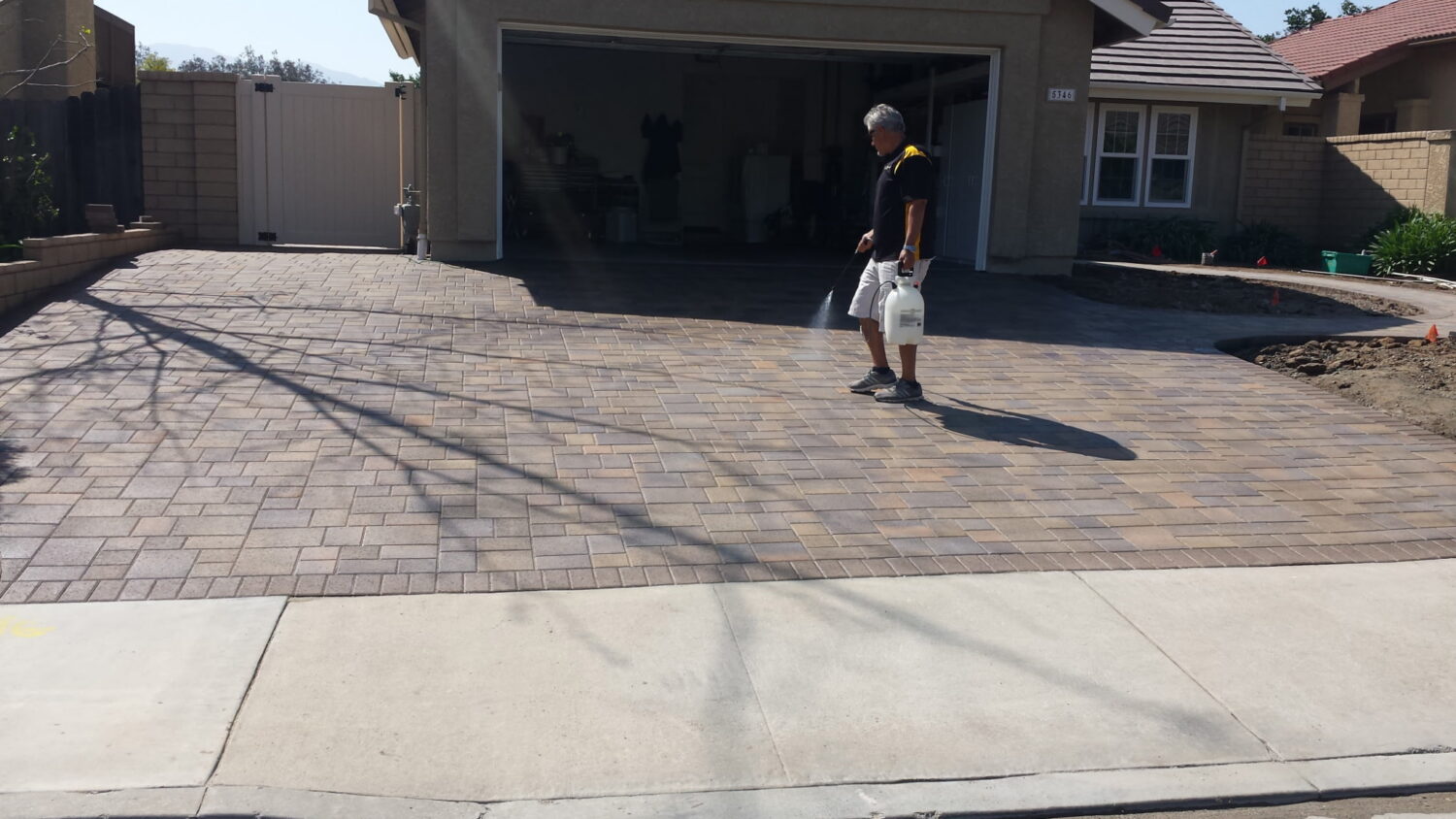
A typical two-car driveway runs about 600 square feet. At the ranges above, expect roughly $5,400 to $10,800 for concrete and $9,000 to $21,000 for pavers. What moves the number: demolition and haul-off of the old driveway, slope and access, the depth of the base, drainage work, decorative finishes and, in some cases, permits. A written quote that itemizes these is the only number that matters.
Permits and HOAs
- Right-of-way work. If your driveway work touches the apron, curb or sidewalk, the Thousand Oaks Municipal Code (§7-2.204(c) and §7-2.301) requires an encroachment permit from the City Engineer. Ask your contractor who pulls it and who pays for it.
- HOAs. Many Thousand Oaks neighborhoods require architectural approval for color, material and pattern. Get it before you order anything.
How to pick a contractor for either one
- Check the license. Verify it on the California CSLB site before you sign. VenCo’s is License #781821.
- Ask about the base. How deep, what material, how is it compacted, and what happens on clay or slopes?
- Ask who does the work. Crew or subcontractor?
- Get it itemized. Demo, base, surface, drainage, permits, cleanup.
- Ask for local work. A driveway they built in Thousand Oaks a few years ago tells you more than a gallery photo.
Why Thousand Oaks homeowners call VenCo
We’re a family-owned Ventura County contractor, and we build both concrete driveways and paver driveways. That means you get a straight comparison for your lot, not a pitch for the one thing we happen to sell. You can also see our local pages for concrete contractors in Thousand Oaks and paver contractors in Thousand Oaks.
Frequently asked questions
Is a concrete or paver driveway better in Thousand Oaks?
Neither wins everywhere. Concrete is the better value on flat or gently sloped lots. Pavers are the better choice when appearance and easy repairs matter most and the budget allows. Slope and drainage should drive the final call.
How much does a concrete driveway cost in Thousand Oaks?
General market ranges run about $9 to $18 per square foot installed, so roughly $5,400 to $10,800 for a 600 sq ft driveway. Your quote will depend on demolition, base prep, slope and finish.
How much does a paver driveway cost?
General market ranges run about $15 to $35 per square foot installed, so roughly $9,000 to $21,000 for 600 sq ft.
Can you install pavers on a sloped driveway?
Sometimes. ICPI guidance flags slopes above about 7% as needing engineering, with a deeper base and edge restraint. If your driveway is steep, concrete is often the simpler option.
Will my driveway crack in clay soil?
Any driveway can if the base is wrong. A compacted, draining base, proper control joints (for concrete) and fabric over clay reduce the risk a lot.
Do I need a permit?
If the work is in the public right-of-way, such as the apron, curb or sidewalk, the city requires an encroachment permit. Your contractor should tell you up front who handles it.
When is the best time to build a driveway in Thousand Oaks?
Dry weather is best for base work and pouring. With a wetter winter possible, booking this fall helps you avoid delays.
Get a straight answer for your lot
Not sure which one fits your driveway? Call VenCo at (805) 890-6189 or request a free estimate. We’ll look at your slope, soil and budget and tell you what we’d build.